
Why Life Cycle Assessment Is Essential for Sustainable Mining Projects?
Life Cycle Assessment (LCA) has become an essential approach in modern mining activities.
Mining activities play a critical role in supplying the minerals and metals needed to drive economic growth and support societal development.
However, amid growing environmental concerns, the mining sector increasingly faces pressure to reduce its environmental footprint.
At the same time, regulators and stakeholders demand that mining operations align with more stringent Environmental, Social, and Governance (ESG) standards.
In response to these challenges, mining companies must rethink conventional practices and adopt more comprehensive assessment tools to ensure long-term environmental sustainability and security for future generations.
Across the entire mining value chain, Life Cycle Assessment (LCA) provides a key framework for evaluating and improving environmental performance.
More specifically, Life Cycle Assessment (LCA) assesses the environmental impacts of products and services by considering their entire life cycle, from raw material extraction to waste management. Every industry generates waste, and the mining sector is no exception.
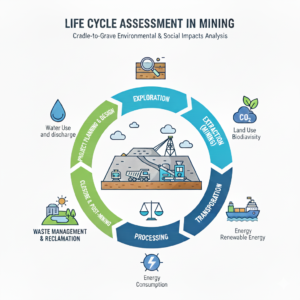
Within the mining industry, LCA analyzes the environmental effects of each stage of the process, from exploration and extraction to processing, transportation, and waste disposal.
This approach provides a more comprehensive picture than focusing on a single stage of the mining process. LCA also helps identify the most significant activities, offering insights into how the sector can improve performance and achieve greater sustainability.
LCA offers significant benefits for mining projects in several key areas:
Identifying Environmental Hotspot
Using LCA, mining companies can identify critical “hotspots” across the mining activities life cycle where environmental impacts are most significant, such as energy consumption during extraction or greenhouse gas emissions during transportation.
As a result, this enables companies to focus on the most impactful areas and develop more effective mitigation strategies.
Supporting Sustainability Policies and ESG Standards
As the focus on sustainability increases, Life Cycle Assessment (LCA) has become a vital tool in corporate ESG reporting.
Consequently, by using LCA, companies can demonstrate their commitment to improved environmental management and to minimizing negative impacts on ecosystems and communities.
Optimizing Resource Use
Life Cycle Assessment (LCA) helps assess the efficiency of resource usage throughout the mining life cycle by identifying opportunities to reduce waste and resource consumption.
For example, the adoption of renewable energy and environmentally friendly technologies in mining processes illustrates how LCA can enhance operational efficiency and sustainability.
Supporting Environmental Compliance and Regulations
Many countries and regions, including Indonesia, are tightening regulations related to the environmental impact of industrial activities.
In response, by using Life Cycle Assessment (LCA), mining companies can ensure compliance with environmental regulations and adapt to evolving standards.
LCA Applications in the Indonesian Mining Sector
Indonesia, as one of the largest mineral producers in the world, faces significant challenges in ensuring that its mining activities are sustainable.
Mining projects for minerals such as nickel, copper, and bauxite require careful management of environmental impacts.
A study conducted in Indonesia demonstrates that Life Cycle Assessment (LCA) helps assess the environmental and human health impacts of critical mineral mining, such as nickel, by identifying processes that affect water, soil, and air quality and by supporting the development of more effective mitigation strategies.
For example, in limestone mining in Indonesia, companies use Life Cycle Assessment (LCA) to assess environmental impacts, particularly greenhouse gas emissions and water consumption.
As a result, the findings show that improvements in technology and operational methods can significantly reduce negative environmental impacts.
Global Trends and the Implementation of LCA in Mining
Globally, the mining sector increasingly applies Life Cycle Assessment (LCA).
For instance, in China, practitioners use LCA to assess the impacts of water use in mining operations, with a focus on improving water efficiency and reducing pollution generated by mining activities.
Meanwhile, the Life Cycle Initiative Report published in 2024 highlights the importance of adopting life cycle thinking in mining to inform better policy formulation and business strategies.
This report demonstrates how LCA applications can accelerate the global transition toward more environmentally friendly and sustainable mining practices.
LCA enables mining companies to make better and more informed decisions while improving their overall sustainability performance.
For countries such as Indonesia, which have large mining sectors, LCA can play a key role in managing environmental impacts while continuing to support economic growth.
Therefore, integrating LCA into every stage of mining projects represents not only a strategic decision but also a necessary step toward a greener and more responsible future.
References
[1] R. Soto-Vázquez, “Life-cycle assessment in mining and mineral processing: A bibliometric overview,” Green and Smart Mining Engineering, vol. 2, no. 1, pp. 73–83, Mar. 2025, doi: 10.1016/j.gsme.2025.02.001.
[2] X. Wang, C. Zhang, J. Yuan, X. Sui, S. Di, and H. Wang, “Life Cycle Assessment of Mine Water Resource Utilization in China: A Case Study of Xiegou Coal Mine in Shanxi Province,” Sustainability, vol. 17, no. 1, p. 229, Dec. 2024, doi: 10.3390/su17010229.
[3] Y. Wahyono et al., “Evaluating the impacts of environmental and human health of the critical minerals mining and processing industries in Indonesia using life cycle assessment,” Case Studies in Chemical and Environmental Engineering, vol. 10, p. 100944, Dec. 2024, doi: 10.1016/j.cscee.2024.100944.
[4] A. Murodif, A. M. Fauzi, Erizal, and L. Karlinasari, “Environmental Impact of Limestone Mining Using A Life Cycle Assessment Method,” Jurnal Pengelolaan Sumberdaya Alam dan Lingkungan (Journal of Natural Resources and Environmental Management), vol. 15, no. 1, p. 122, Jan. 2025, doi: 10.29244/jpsl.15.1.122.
[5] Life Cycle Initiative, “Life Cycle Initiative Annual Progress Report 2024,” 2025. Accessed: Dec. 15, 2025. [Online]. Available: https://www.lifecycleinitiative.org/2024-life-cycle-initiative-annual-progress-report-published/